Introduction
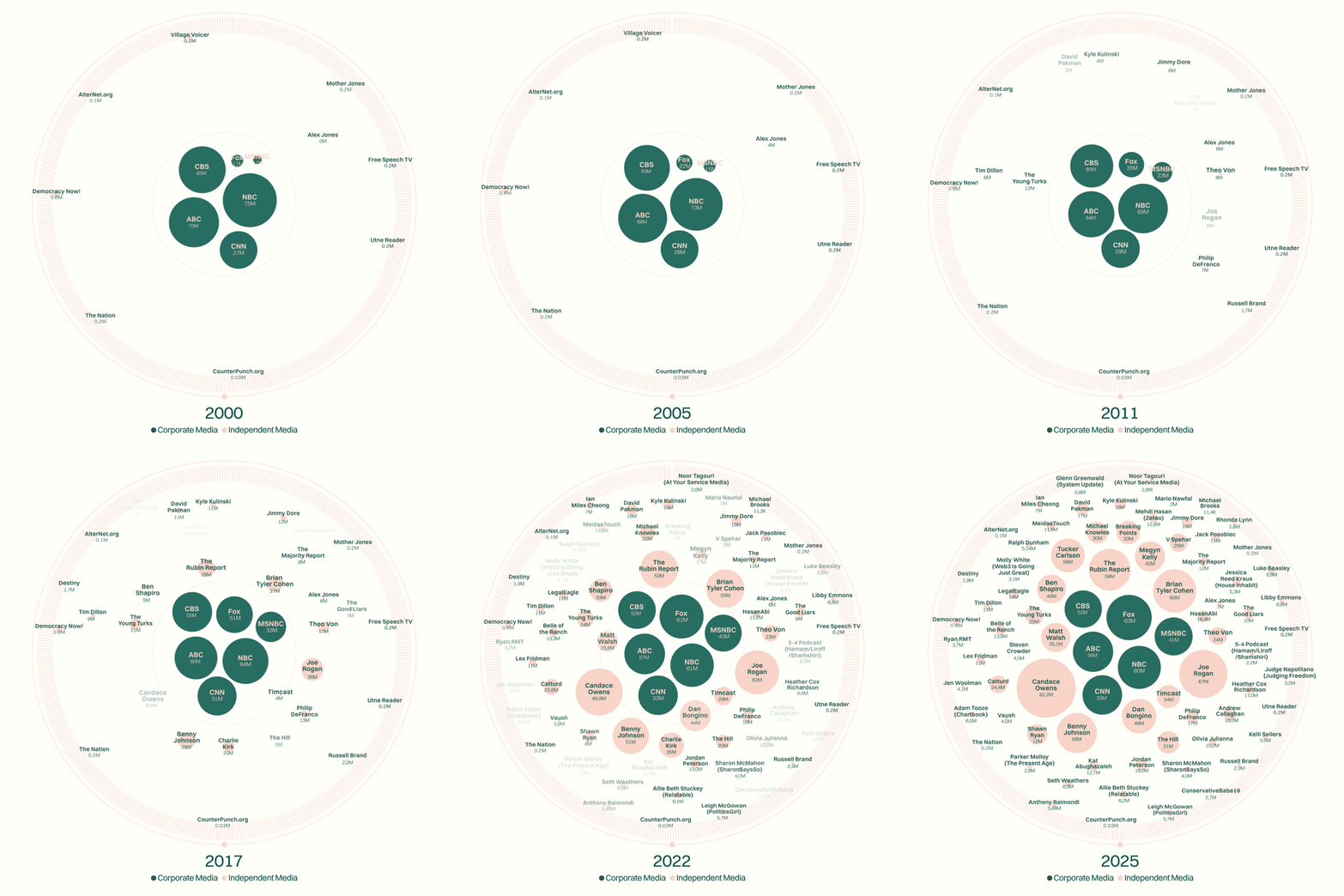
One of the most surprising pieces of research we assembled during The Age of Wisdom series centered on US Media from 2000 to 2025; it reveals a pivotal transition (in dynamism and audience size) from a handful of corporate media to a multitude of independent, networked, media sources over the course of 25 years. We believe this is generally good news for the health of the human information network, and thus for truth and progress. More below...
So this month we’re doing a deeper dive on US media dynamics and on how this counter-intuitive trend impacted US media generally - incredible, also, that it only kicked into high gear in the last 5 years (essentially since Covid, though no causation implied).
We are also revealing our Zulu Digital Microscope - an interactive visualization that maps the evolving media network landscape (starting with the U.S. media ecosystem). The project’s goal is to build a shared epistemic infrastructure that makes the health of our information networks visible, measurable, and ultimately improvable. It will grow as new data and members are added.
Here’s how we collected the data:
Corporate media definition: large, pre‑internet legacy news outlets owned by major conglomerates (TV networks, cable news, big newspapers) with institutional newsrooms and corporate control.
Independent media definition: editorial independence, digital‑first news and commentary created and controlled by individual creators, very small teams, or nonprofits.
We estimated a Unique Monthly Audience (UMA) for each outlet by combining publicly visible reach metrics from websites, YouTube, podcasts, and social platforms into a single cross-platform figure using a standardized 30-day rolling window, then applied probabilistic de-duplication factors based on each outlet’s main platform and media type to reduce audience overlap and produce comparable reach estimates.
For corporate conglomerates, UMA is first estimated for each sub‑brand (e.g., CNN, HLN, NBC News, TODAY), then a second de‑duplication pass is applied across the whole family to account for overlapping audiences, producing a single portfolio‑level figure rather than a simple sum, informed by sources like Nielsen TV ratings, Nielsen DMA reports, Audit Bureau of Circulation/Editor & Publisher, and AP/wire‑usage research.
>> Here are the essential insights from the data
Diversity as an epistemic stabilizer
TL;DR: More different voices make it harder for false ideas to survive.
Greater ideological diversity reduces the risk of collective error by increasing the number of independent perspectives within an information network. When many distinct voices operate in parallel, contradictions emerge earlier, false claims are harder to sustain, and more coherent explanations are more likely to survive through iterative error-correction (versus consensus by conformity).Connectivity as a defense against disinformation
TL;DR: When many people are connected, lies fall apart faster.
Dense connectivity between creators, platforms, and audiences increases resilience against coordinated disinformation. High link density accelerates feedback loops and multiplies points of scrutiny, making it far more difficult for concentrated (special) interests to shape narratives than to influence a small number of centralized editorial gatekeepersThe rise of the independent tier
TL;DR: Independent creators changed how information gets challenged and discussed.
The expansion of independent media has structurally reshaped the epistemic dynamics of the information ecosystem. Long-form interviews, livestreams, and interactive comments enable rapid, audience-driven feedback and reduce hierarchical gatekeeping, creating a more conversational and permeable environment than the tightly siloed media landscape of the early 2000s.Long-form depth and epistemic openness
TL;DR: Longer conversations reveal more truth than short clips.
Extended, minimally pre-packaged formats promote epistemic openness by requiring coherence under prolonged scrutiny by audiences and interviewers alike. These formats support exploratory reasoning, revision, and clarification over time, while legacy television news (constrained by time slots and advertising incentives) relies more heavily on short interviews and soundbites that often limit contextual depth.Divergent incentive structures
TL;DR: Who pays the bills influences what gets said, and not.
Different incentive structures shape how truth claims are produced and constrained. Corporate media benefits from professional training and institutional guidelines but (mostly) operates with ownership and advertising pressures that limit narrative range. Independent media, by contrast, is primarily accountable to diverse audiences and subscribers, encouraging adaptability and internal coherence over deference to external interests (including government).Decentralized accountability
TL;DR: Many independent watchdogs are stronger than one official one.
A broad distribution of independent voices across the political spectrum functions as a decentralized system of accountability. These edge nodes publicly test and challenge institutional narratives, creating a form of networked oversight in which claims are continuously interrogated without reliance on a single authoritative arbiter.Cross-tribal audience flow
TL;DR: People are mixing news sources and ideologies more than before, despite polarisation.
Audience behavior increasingly reflects cross-tribal consumption rather than fixed ideological alignment. As viewers engage with both independent and legacy sources, issue-by-issue evaluation replaces strict partisan loyalty, weakening informational silos and supporting greater epistemic independence. This is in tension with algorithm-driven polarisation in social media.Rising information density
TL;DR: Media now carries more depth per hour than it used to.
The growth of independent long-form audio and video has increased the overall information density of the media environment. Exploratory and dialogic formats transmit greater contextual and narrative bandwidth than sound-bites, and their ability to attract audiences comparable to legacy outlets signals a systemic shift toward deeper modes of content consumption.
Subscribe
Subscribe
>> Staying vigilant: what to look out for
Understand the incentives, and the stated values, of your sources: all outlets, from the smallest independent voices to the largest corporate machines, are subject to implicit bias of their teams or explicit distortion of the agendas they serve. A number of independent media outlets have hidden agendas, powered often by funding which is obscured from viewers. As independent media outlets grow, it becomes tempting to adopt corporate habits: advertising pressures, larger teams, and eventually corporate shareholders. This is not necessarily always bad, but it does add risk.
The Zulu take
Mamdani win augurs better times
Winning the mayoral election in America’s most populous and important city is a significant feat in itself. Doing so using only grass-roots funding, a charismatic and hopeful message, and facing entrenched interests on third-rail issues, is both impressive and augurs better times for American democracy.
Avg Joe has more information than any ruler in history — yet far less power
Human civilization’s knowledge, cultures, and the world more broadly has never been as accessible and equitable as it is today. Forget for a second what risks the future may or may not hold, this marks the end of an era-defining shift: knowledge without authority has replaced authority without knowledge.
Social media exodus good for mental health
People are moving away from traditional social media that’s built to grab attention and sell ads as endless scrolling and manipulative algorithms’ dangers are exposed. Users are instead choosing more intentional and private ways to connect with eachother and to get information: they are taking control of their mental health, which is a good thing.
Heros don’t need capes, or guns, or a particular religion
Sydney rescuer Ahmed Al-Ahmed impressed us not only with his selfless bravery, but by reminding us that courage and empathy are marks of the best amongst us, not of any religion - the religion of both the hero and the victims is irrelevant.
Inspired by John Stuart Mill’s argument in On Liberty.
Subscribe
Subscribe
Share to:
© 2025 Zulu Group Ltd. All rights reserved.