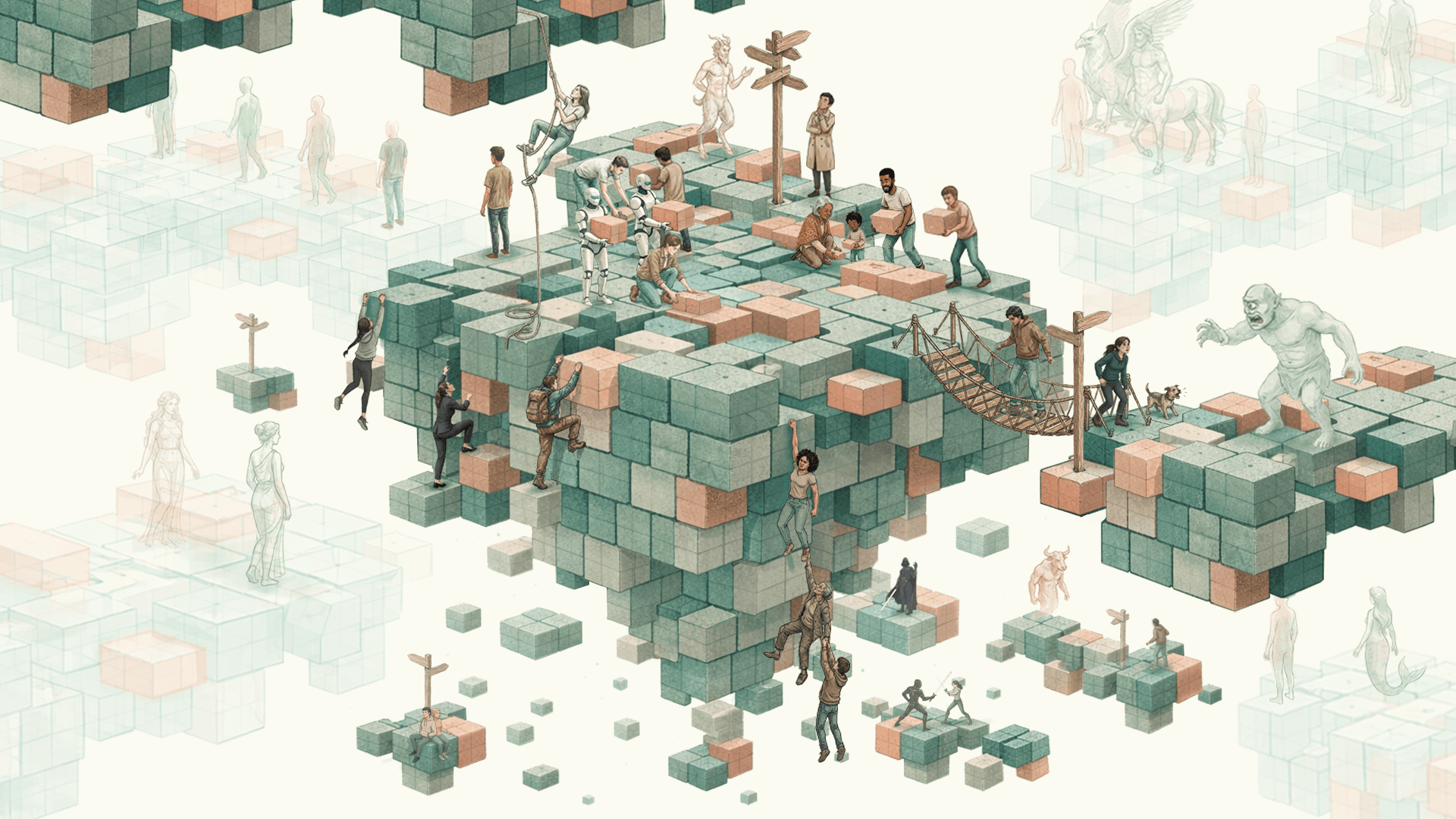
We live in the most knowledgeable era in human history, yet across many societies, social fragmentation and existential uncertainty continue to rise. Why hasn't access to more knowledge and cognitive power brought more meaning? We believe the answer lies in returning not to organized religion, but to the power of mythology.
Since the earliest organized human civilizations - dating back to circa 10,000 BCE with sites like Göbekli Tepe - we have used mythology to answer fundamental questions about reality and the human experience. When we looked up at the stars, or inward to our own thoughts, we would depend on mythology to help us find meaning and psychological security.
Myth, in this case, does not mean falsehood but narrative frameworks through which humans have made sense of meaning, identity, mystery and morality - stories that guide us through the unknown. What Yuval Noah Harari calls 'collective fictions', are the essential glue that allow large-scale human cooperation; an operating system that gives instructions to individuals on what to do in order to live coherently within society and within the world.
In early societies, myth emerged from oral storytelling as the primary way of understanding the world and one's place within it. Around fires and in ritual spaces, stories of gods, ancestors, monsters, and heroes explored existence, suffering, and how people should live and build together.
American writer and pioneer of comparative religion, Joseph Campbell (1904-1987), observed, "myths are public dreams; dreams are private myths." When we started to communicate with each other more consciously we wove together stories that made sense of our collective reality. Early traditions - Sumerian, Egyptian, Vedic, Greek, Indigenous - were not separate from life; they integrated cosmology, morality, memory, and identity into narrative form that propelled their societies forward.
Myth is the interface between existing knowledge and the vast infinite of the unknown. Over time, it was absorbed into formal institutions. Religious dogma often treated mythic narratives not as symbolic frameworks for living, but as ideological absolutes. Oftentimes they served as mechanisms of control as much as liberation. Metaphor hardened into doctrine; ambiguity gave way to certainty. What had once helped humans live with mystery was, at times, repurposed to eliminate it.
The scientific revolutions of the early modern period made the natural world intelligible through cognitive and experimental mechanisms rather than solely through divinity or faith, enabling profound advances in medicine, astronomy, physics, and our understanding of natural laws.
German sociologist Max Weber (1864-1920) described this shift as the "disenchantment of the world." Yet disenchantment did not eliminate myth - it just displaced it. As science took on the task of explaining how the world and our bodies work, the mythologies of canonical religion retreated from cosmology and morality and expanded elsewhere: art, literature, and, in many societies, cinema. There it addressed questions science was never going to answer particularly well: meaning, feeling, suffering, identity, and mortality.
No matter how much of reality is explained by scientific discoveries, the scope of human experience and our desire for meaning remains unbounded; its permutations infinite. Mythology's role is no longer there to explain why the sun rises or why we lost a war, but rather serves as a guide for how to put one foot in front of the other in service of a greater goal or adventure that's unique to our lives.
As the scale of common knowledge about science expanded, literal interpretations within traditional religion stopped making sense. They simply couldn't compete with empirical science in explaining reality. We began slowly to accept religious stories as metaphor rather than literal truth, pushing our faith further away from lived experience. Thus secularism arose as a necessary compromise when societies found themselves caught between two ways of understanding (and mastering) the world: the mythological wisdom embedded in religious tradition and the observable truths revealed by science. Rather than forcing a choice between them, secularism allowed both to operate in their respective domains - the sacred and the empirical, each retaining value without claiming outright control over the other.
In time, cinema functioned as a quasi-secular mythology, offering collective narratives of sacrifice, moral struggle, a call to adventure, and belonging. A contemporary example of a story that follows a mythological framework is Star Wars. George Lucas was heavily influenced by Joseph Campbell's magnum opus 'The Hero with a Thousand Faces' when creating Star Wars, and the two later became friends and discussed the mythological elements Lucas had incorporated into the saga. It is no accident that Star Wars became, for many of its fans, a partial replacement for religion. We could connect to the story's characters and imagine our own 'hero's journey' through them.
The digital era, however, may have fractured this symbolic space. While long-form storytelling through film, books, or extended TV series, can still explore moral choice in depth, these forms are losing prominence. We've lost the ritual that binds us to a complete story or spectacle. Actor Matt Damon, recently expressed concern that streaming platforms are altering traditional storytelling by demanding that scripts feature repetitive, attention-grabbing plot points to cater to viewers who are distracted by “second-screening” on their phones. In turn filmmakers sacrifice complex, slow narratives for immediate engagement, affecting how stories are structured and, presumably, interpreted.
The conditions that once allowed mythic narratives to operate - immersion and total focus - are increasingly strained by systems optimized for novelty and instant reward. As Marshall McLuhan warned, the medium reshapes not only what we consume, but how meaning itself is formed.
In this environment, myth mutates further. Political ideologies and public figures adopt quasi-mythic roles of ‘heroes’ and ‘villains’. They don't feel authentic because they aren't. They rarely represent coherent moral philosophies.
Thus myth survives as a vacuous spectacle: tech entrepreneurs and business leaders (not all!) celebrated as heroes of monetary ambition without moral restraint. The narrative celebrates visibility and winning above all, even when ‘success’ involves indefensible moral shortcuts and no obvious moral goal.
This characterizes the present moment: myth endures without the coherence or humility required to actually guide human lives. Science and engineering can explain how natural systems work and build extraordinary technologies like AI, gene-editing, rocketry, or robotics. What they cannot determine is how we should live with them. How should dignity, responsibility, and value be understood when cognition and labor are no longer uniquely human? What forms of work, meaning, and belonging remain when intelligence becomes embodied outside the human body? And what narratives will allow societies to orient themselves amid such a transformation?
The challenge ahead is mythological, not technological: whether societies can cultivate frameworks of meaning capable of managing new forms of scientific discovery without collapsing into social disorder or worse: mythologies that prioritise computers or cyber-organisms instead of caring for people and the biosphere that sustains us all.
Atheism and secularism are appealing because they dismiss religion and mythology entirely, as ahistorical and detached from empirical science. But they may be throwing the baby out with the bathwater.
We still need mythology - but we need to recycle and repurpose our mythological traditions for our modern age. Myth has never been a rival to knowledge. Where knowledge explains our reality, myth orients us on where to go next and how to feel a unique reward from that journey. Consider how the world's major religious traditions, when read metaphorically rather than literally, still offer valuable life guidance:
~ The New Testament reminds us that people can fundamentally change, that sacrifice and forgiveness hold meaning, and that loving one's enemy offers an alternative to cycles of violence. These frameworks could guide us toward compassion and belief in the possibility of human redemption.
~ Islam's teaching of tawhid (divine unity) and humanity as khalifah (Earth's steward) emphasize interconnectedness and sacred responsibility for nature, offering a moral foundation for environmental consciousness in an age of ecological crisis.
~ Judaism’s Shabbat insists on weekly withdrawal from work and consumption to create space for reflection and community. In our always-on, burnout culture, this framework could promote mental health.
~ Core Buddhist teachings (that suffering arises from attachment) may provide psychological insight aligned with cognitive science. Indeed, regular meditation strengthens neural connections and increases gray matter in areas linked to memory and emotional regulation.
~ Hindu concepts like dharma (righteous duty) and karma remind us that our actions have consequences, we each have evolving roles and responsibilities, and both creation and destruction are necessary. This could provide a framework for ethical living and finding purpose through contribution.
~ Ho’oponopono (ancient Hawaiian spiritual practice) begins by taking responsibility for your inner world, acknowledging and releasing negativity through forgiveness, gratitude, and love. As you restore peace within yourself, you help restore harmony in your relationships and the world around you.
What is required now is the recovery of myth's original function: stories guiding humans to live well and harmoniously within a vast reality that cannot be fully known or mastered.
Each of us can interpret and inherit the teachings from our own religious backgrounds, finding wisdom in traditions and events that shaped our families and cultures - and others’. The path forward perhaps lies in integrating our collective religious inheritance(s) with universal moral principles and our best explanations of nature. This approach allows us to honor where we come from while creating new personal mythologies that are scientifically honest yet rooted and spiritually nourishing. In a sense, we can reclaim life’s deeper adventure and our own ‘hero’s journey’.
At Zulu Group, we're exploring better ways to bring history to life, making its stories more palpable and relatable. We can be inspired as much by the achievements of neighbouring civilizations as our own. Look out for more on this theme in the months to come.
- Amelia Earhart
Subscribe
Subscribe
Share to:
© 2025 Zulu Group Ltd. All rights reserved.