Within minutes of your birth, they have decided your name, your god, your country, and your people. The impression is so profound that most men and women will sooner doubt their own existence than question any of it. (Schopenhauer, 1788-1860 CE)
Introduction
I was born into a civilizational crossroads. My early years were spent in Lebanon - fifteen religious denominations sharing land the size of Los Angeles County. My father's Greek Orthodox family gave me French, Arabic, good food and Levantine business instincts. Via my Russian and English-Jewish mother, I later added British humour, boarding school mannerisms, gratuitous self-deprecation, the long shadow of Imperial Britain, and a myopic retelling of Western history. Eighteen years in California diluted some of that in exchange for flip-flops, a frisbee, and a passion for solving problems with design and technology.
So if anyone should know that cultural identity is inherited and accidental, rather than chosen, it's me. And yet I still catch myself believing, without quite knowing why, who I am supposed to love, or hate, and how; what each cultural ingredient expects of me; which failures would constitute betrayal, and of whom. The wiring runs deeper than any of us can imagine - a cage containing the richness of language and literature, mastery of nature, refined ways of doing things, but also the unconscious pain of our collective past. Once you know it's a cage, though, you are compelled to unpick its lock.
Which brings me to the one question this essay asks of you: how much of what feels like your own thinking is actually the thinking your culture expects of you? Where does your inheritance end and your independent judgment begin? Do you even know the difference?
We don’t get to control our cultural inheritance or our neurology, but with enough awareness we can control what we do with them - not just as individuals, but also as a civilization.
This essay aims to surface some ideas on how to do that.
Rubio’s Blunder & Civilizational Humility
When Marco Rubio, the US Secretary of State, invoked notions of ‘Western Civilization’ at the Munich Security conference in February 2026, most of his supporting evidence was ahistorical and incoherent, even if it tugged at the in-group inclinations of his audience.
His speech conjured a Western civilization built on “European Values” that never existed, at least not in the way he claims. He credits Europe with inventing the rule of law, apparently unaware of Hammurabi’s Code, and with creating the university, apparently unaware of Al-Qarawiyyin in Fez, that was founded in 859 CE, two centuries before Bologna. He credits Europe with the Scientific Revolution while omitting that it ran on Arabic algebra, Indian numerals, and Hellenic texts that had been preserved and transmitted back to Europe by Islamic and Byzantine scholars for almost 800 years.
This is not to discredit the significant cultural achievements of Europeans as a whole or indeed of ‘The West’, but if we must assign credit, it’s important to be factual and balanced.
The very notion of Western civilization as a coherent, unified bloc collapses on contact with the actual historical record: for most of the last millennium, the nations Rubio lumps together were busily slaughtering one another - in the Hundred Years’ War, the Thirty Years’ War, the Napoleonic Wars, and two World Wars so catastrophic they required the construction of entirely new international institutions just to stop it happening a third time.
Perhaps his actual argument was that the US’s unipolar military and economic dominance is threatened, implying therefore that Europeans should ‘feel threatened too’. The fact that it might have worked on his audience demonstrates how susceptible we are to in-group flattery.
Rather than signalling an opportunity for deeper connection with the wider world, Rubio was signalling separation: East vs West, Liberal Democracies vs Flawed Democracies, One-Party States, Monarchies, Religious States, and so on. The notion that the Western World is comparatively peaceful today is precisely because it managed to transcend its own militaristic-nationalistic period, in the aftermath of WW2. This dance has existed at each seminal moment in history, as one level of group consciousness evolves towards another through collision, conflict, and peace-making.
We already taste the enormous benefits of non-zero-sum dynamics in the tightly knit global economy that gives us cheap smartphones, cheaper clothes and bananas all year round. This is partly why we need Russian oil despite ‘principled’ economic sanctions on Russia, and persistent Chinese manufacturing despite nominal threats to Taiwan’s sovereignty. We try to reconcile our interdependent global network of societies with our parochial civilizational outlook, but we can’t.
Philosophical contradictions have always existed between, for example, the US and China, apparent adversaries. And historic progress was made despite them.
Deng Xiaoping’s pivot toward market-led capitalism (Reform and Opening) was catalyzed by the diplomatic work of Henry Kissinger and Richard Nixon’s visit in 1972. The opening came through the realisation of a shared strategic interest (containing the Soviet Union), but it nonetheless worked as a pretext for lowering ideological defences. Deng understood that restoring economic growth required that he set aside Maoist / Communist ideals. America reciprocated. The effects of this moment of civilizational open-mindedness are abundantly clear today in China’s economic and industrial primacy - and likewise in the undeniable fact that China has successfully adapted Western-style market capitalism to its purposes.
The key point here is that we can approach our civilizational horizon with greater historical self-awareness, humility, and creativity. And in doing so, the harmonising of diverse political philosophies (and economic interests) will come more naturally - and less violently.
The Architecture of the Cage
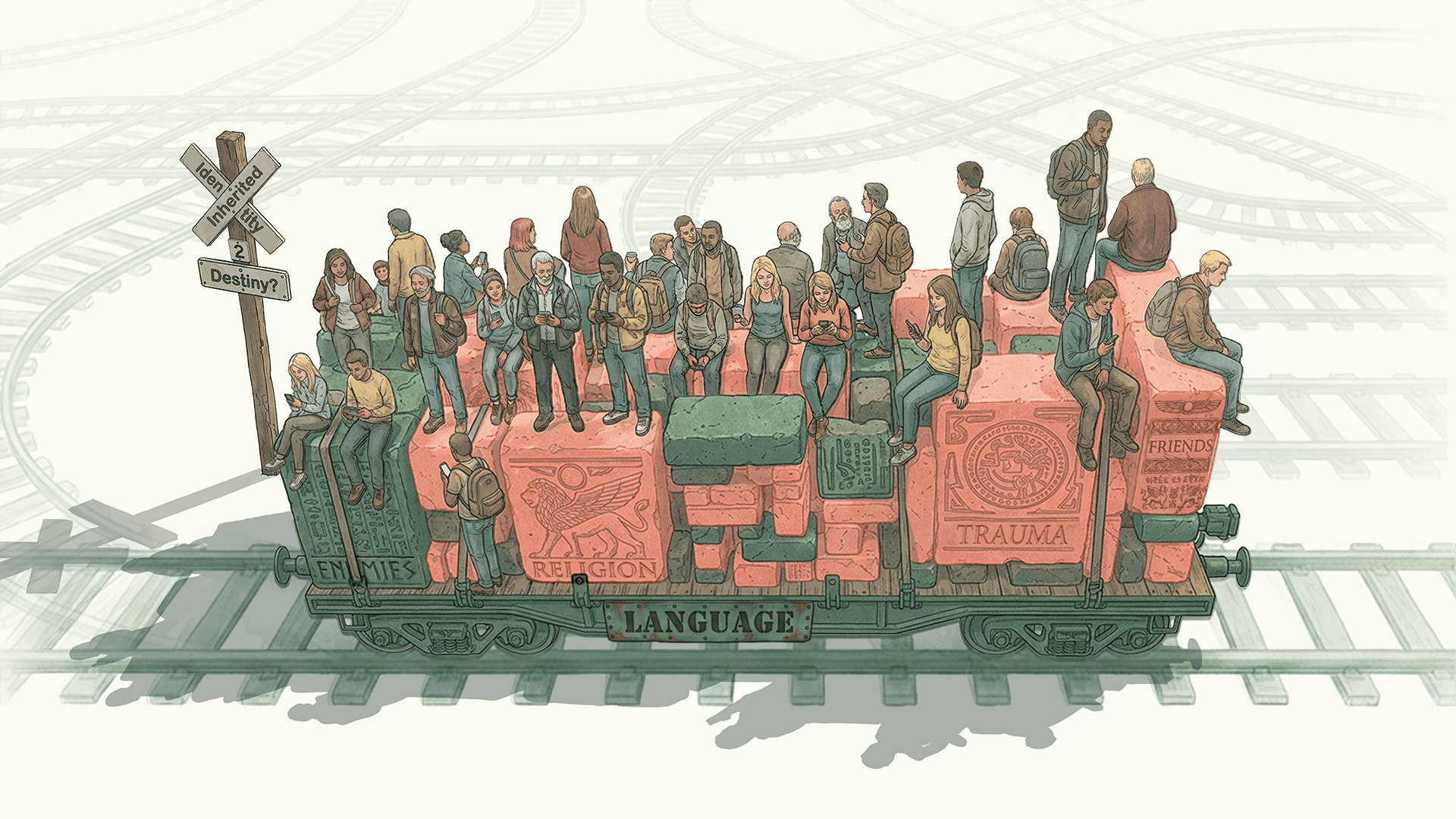
Imagine being loaded onto a railway track at birth. Before you were conscious enough to ask for your destination, the train car had already left the station. The landscape outside the window - the hills, the light, the weather, the language on the signs - came to feel not like one of many views, but like the view. It all felt inevitable.
This ‘track’ is metaphorical of course. In reality, it burrows inward into all parts of our psyche. Language is its deepest instrument: it conveys hierarchies, distinctions, vagaries of humour, categories of friend and foe; it includes words that make certain thoughts easy and others nearly unthinkable.
Ludwig Wittgenstein (1881-1952 CE) said: “The limits of my language mean the limits of my world”. Language thus doesn’t simply describe reality - it constructs it. To speak a language is to inherit a way of thinking about the world.
You did not simply learn your language and cultural identity. You were built by it, at a level deeper than conscious memory, in a period before you had the tools to evaluate what was happening. It is your soil. It is self-referential and, as a result, very hard to transcend.
For example, Arabic has a grammatical dual - a dedicated form for ‘two of something’, distinct from both singular and plural - making ‘two people speaking’ a categorically different thought from ‘people speaking’. Its verb ‘ta’allama’ doesn’t simply mean “he learned”; it carries within it the sense that the learning arose from within him.
Not all inheritance is constraining. Indeed, civilizations would not exist at all were it not for new generations imitating the cultural habits they were born into. That inertia keeps civilizations together and functioning. Civilizations, like families, seek togetherness, even as they evolve organically. Their first instinct, like ours, is self-preservation and with that comes defensiveness. This is, in a sense, the first law of in-group dynamics: defend your group blindly no matter what.
The machinery that produces tribal identity is far older than any of the modern identities it generates. The willingness to sacrifice for your people and fight against ‘theirs’ were adaptive features for small bands of 50 to 150 humans navigating a world of scarcity and predators. For most of human history, your tribe was your life-support system and so to be expelled from it was a death sentence.
The hardware, in other words, was built for a hunter-gatherer world that no longer exists. Henri Tajfel and John Turner’s Social Identity Theory (1970-1980) showed that threatening someone’s group membership is not just an inconvenience but an attack on their self-esteem - their psychological foundation. The experiments also showed that people would discriminate in favour of in-group members even when groups were assigned on the basis of something entirely arbitrary: a preference for one abstract painting over another, or even the flip of a coin.
A more recent study, published in the Proceedings of the National Academy of Sciences (2025) extended this finding further: discriminatory resource allocation emerges even in the complete absence of group identity, arising simply from the perception of difference itself. You don’t need an organized enemy.
Consider what this means. Your allegiance to a football club, a religious denomination (Catholic, Protestant, Sunni, Shia, Alawite, Dudist, etc.), a political party, a nation - things for which some would blindly die - can be totally random anyway. The entire edifice of self, with all its fierce certainties, is balanced on a coin toss.
The brain manufactures tribal tension from almost nothing.
And yet we defend it ferociously, because we believe that not defending it is a form of psychological annihilation. Which is why some arguments are so hard. To question the track you’re on (despite an inner voice hinting that you should) is to risk exile from everyone who knows you and to demolish your own self-esteem. The price of apostasy is the loss of community, family, belonging. The network enforces conformity not through violence alone, but through the threat of fracture from the group.
We seek togetherness as instinct.
“To forget one’s ancestors is to be a brook without a source, a tree without a root.” — Chinese proverb
Networks of belief and identity accumulate inertia over time. They develop institutional architecture such as churches, constitutions, legal codes, cuisines, musical traditions, that makes them progressively harder to redirect. This applies to any coherent cultural system. And as Nietzsche saw clearly: “The most dangerous form of blindness is believing your perspective is the only reality.” The truly trapped person is not the one who knows they are in a cage. It is the one who has mistaken the cage bars for the sky.
Nevertheless, human societies inevitably expand their circle of allegiance - from clan to tribe, from tribe to religion, from religion to nation, and eventually to supra-national blocs - always seeking comfort and protection within the new level of association and consciousness.
If there is any ‘rule’ it is that our group associations, and the self-esteem derived from them, can expand with time and the collision of competing models. The point here is that we can only depart one cage by finding another that makes more sense - by seeking our self-esteem and security in a new model of belonging that builds on those systems we first inherited.
The hint that we are overdue for an upgrade is when we reach a moment of obvious incoherence, cultural stagnation, or decline. Like what ‘The West’ is facing now.
Subscribe
Subscribe
The Mechanics of Collective Trauma
Although conflict has always shaped successive civilizations, there is a particular and devastating sequence that occurs when trauma and humiliation is inflicted on a group at sufficient scale. The logic is awfully consistent.
It begins with genuine, catastrophic injury. A people are defeated, displaced, murdered, and humiliated. Their institutions are destroyed and their sense of collective dignity shattered.
The pain of collective trauma festers and finds new victims, if it cannot be processed or if there is no space for genuine grief, no external acknowledgment, no justice, and no restoration. The injury transforms. The sequence runs, predictably, as follows: injury → shame → denial → supremacy → violence. The group that was broken begins to reassemble itself around the story of its breaking, and that story over time becomes a weapon.
Germany after the First World War is perhaps the most consequential example in modern history. The Treaty of Versailles imposed on Germany not merely military defeat but deliberate humiliation and economic annihilation. It assigned sole moral responsibility for the conflict to Germany, crippled the economy through reparations, and disbanded the military that had been central to national self-conception. The shame was structural. Into it stepped a political program (Nazism) that offered a precise antidote; the conversion of humiliation into supremacy:
You were not defeated because you were weak. You were stabbed in the back by enemies within (Jews, communists, homosexuals) who had betrayed a nation that was in fact exceptional and destined.
The shame was inverted rather than being processed. The war and violence that followed was not separate from the trauma - it was a direct expression of it. The Holocaust of 1933-1945 was one of the most systematic acts of destruction ever visited on a people: approximately six million killed and a collective trauma that was, by any measure, all-encompassing for those who survived.
The founding of Israel (a 19th Century idea that had never gained steam) in the immediate aftermath was a collective psychological response to that trauma and supported by the guilt of Allied powers. It was a declaration that the vulnerability which had made the Holocaust possible would never be permitted again. ‘Never again’ was not merely a slogan. It was the conversion of the identity of the victim into the identity of a sovereign power that could protect itself. The logic is understandable; it is what traumatized individuals do when they gain agency. They build walls and develop hypervigilance. They reorganise themselves around a North Star of ‘survival no matter what’.
The tragedy is that this reorganization often reproduces the very patterns inflicted on the original victims - in this case, the expulsion and subsequent domination over the indigenous non-Jewish Palestinians. These are the behaviors not of people who have healed from trauma but people still living unconsciously inside it, unable to see that the logic of supremacy they are now deploying is the same logic that was previously deployed against them. The oppressed do not automatically become the liberators.
“The vanquished always want to imitate the victor” — Ibn Khaldun, 1332-1406 CE
This is not a political argument about territorial rights. It is a psychological observation about what happens when collective shame is converted into political power without the intermediate step of collective healing. The pattern runs through the history of empires and of every group that has been broken and then, given the chance, has broken others.
The legitimate grievances of the dead have a way of becoming the convictions of the living - moulded to suit new threats, and rarely questioned. This is how unprocessed collective trauma moves forward through time, looking for a form. It finds the children and grandchildren and gives itself to them as identity. It finds the opportune political moment and offers itself as ideology. It looks for anything that can heal the shame and restore self-esteem. It finds the perceived threat and presents itself as righteous self-defence.
Israeli intellectuals Yeshayahu Leibowitz and Boaz Evron were among those who raised alarms early, with Leibowitz accusing Israel of “Nazification” and Evron warning that Israel was displaying “racist Nazi attitudes”. The goal (a dream of a Jewish homeland) had been justified but the methods (Palestinian dispossession and killing) were not.
A passing scan of recent conflicts reveals many examples of unhealed collective trauma transformed into violent movements: the oppression & bombing of Shia community in Lebanon > the rise of Hizbollah militia; the Western bombing and colonialism in Cambodia > the Khmer Rouge and killing fields; institutionalised Tutsi dominance of Hutus > the Rwandan genocide; and so on.
Trauma, left unresolved, seeks new victims. The survivors (and their descendants) who cannot grieve, be supported through healing, will eventually find someone innocent to punish for what they survived. Why should I care for others, if I’m convinced that others don’t care for me? Understanding this sequence is not an act of moral equivalence. It is important because if unhealed collective trauma can start world wars, genocides, and mass displacement then it is indeed a formidable force in the shaping of our civilization(s) - and should be treated as such.
Cultural Collisions are Generative
There is also a paradox.
To fight a perceived enemy effectively we must study their language, customs, the way they pray and grieve. We must attempt to explore their ‘track’. And in doing so, we often re-humanize them because we access universal truths about humanity and life as a whole. This requires us to contemplate our in-group instincts and fear of others, even if temporarily, from a different point of view.
The military historian John Keegan documented this most vividly in the bizarre intimacy of the World War I trenches, where British and German soldiers shared tobacco through gaps in the barbed wire and famously played football together on Christmas Day (before resuming battle). Gordon Allport in his 1954 Contact Hypothesis explains that prejudice dissolves through structured encounter: equal-status contact, shared goals, the necessity of cooperation. Like Nixon and Deng.
Indeed, history’s greatest civilizational flowerings have, almost without exception, been moments of orderly collision. Between 700-1100 CE, Andalusia provided a unique hub of cultural exchange and religious tolerance under Muslim rule, as did Norman Sicily (1072-1194) whose rulers had become so comfortable with their Muslim and Jewish cohabitants after conquering the island that they ignored papal orders to join the Crusades.
Tang Dynasty China (618-907 CE) offers another sweeping example: at its height, Chang’an was the largest city on earth and an exemplary crucible of encounter: Persian merchants, Arab traders, Nestorian Christians, Buddhist monks, Zoroastrian priests, and Confucian scholars sharing goods, musical forms, craftsmanship, astronomical knowledge, and agricultural techniques from across the known world.
The result was an explosion of poetry, painting, medicine, and statecraft that China still regards as its classical civilizational peak. It is perhaps no coincidence that contemporary China, having spent several decades absorbing the best of American technology and product practices, has within a generation become a peer competitor in almost every field: robotics, clean energy, communications, EVs, etc. The formula for civilizational growth remains the same after a thousand years: purity is stagnation, mixing is generative.
Indeed, 55% of Silicon Valley’s landmark companies – including Apple, Google, eBay, SUN, Cisco, NVIDIA, and my own Jawbone - were founded by immigrants or their children. The Bay Area’s formula is the same as Andalusia, Tang China or Renaissance Venice: a stable, confident cultural foundation that gives room to a diversity of cultures generates non-linear creative outputs.
The Limits of Openness: Designing for Contact
There is a counterargument, articulated with increasing force by Elon Musk and others ‘Western civilizationists’, that frames cultural openness as “suicidal empathy” - i.e. openness is a lowered drawbridge, no longer a virtue but a vulnerability waiting to be exploited.
A person with no stable core is not enlightened but colonisable by the most aggressive identity system in the room. Societies, it follows, are no different. Samuel Huntington famously made the philosophical case in The Clash of Civilizations, that liberal universalism is itself a culturally particular worldview. To insist that everyone wants the same things and will converge on the same institutions is not open-mindedness, it is a failure of (anthropological) imagination dressed up as tolerance.
There is a real kernel here. But the conclusion mistakes the diagnosis for the prescription.
A tree is not a tumbleweed. Deep roots do not prevent growth; they enable it. The psychological literature on secure attachment offers a good model for what healthy cultural identity looks like at scale: a child confident in a stable base of love becomes more willing to explore, not less. Securely attached individuals seek encounter with the unfamiliar because they are not threatened by it. The anxious cling to the familiar because any challenge to their existing model feels like an attack on their self-esteem, and thus their existence. The pattern holds for civilisations as much as for children.
The real problem the ‘suicidal empathy’ critique identifies is not empathy per se but the dangers of asymmetry - one civilisation lowering its defences while another keeps theirs raised. This is a genuine coordination problem, much like the WW1 soldiers attempting to share a cigarette in no-man’s land.
But the answer to a coordination problem is neither unilateral defection nor an iron curtain. It is the construction of better coordination mechanisms: equal-status exchange, trade networks, shared scientific endeavours, diplomatic frameworks that create genuine reciprocity. Setting a sensible boundary in geopolitics or immigration is not tribal regression. It is the precondition for a genuine encounter and growth.
“Mr Gorbachev, tear down this wall” — Ronald Reagan, 1987
Metacognition: Transcending the Cage
The in-group instinct cannot be eliminated. This is not pessimism - it is biology. Oxytocin, the molecule most associated with human bonding and love, simultaneously deepens our attachment to those we consider ours and sharpens our suspicion of those we consider ‘other’. The same neurochemistry that makes you willing to die for your children makes you capable of killing for your opponents. These are not separable features. They are the same feature, operating in different directions.
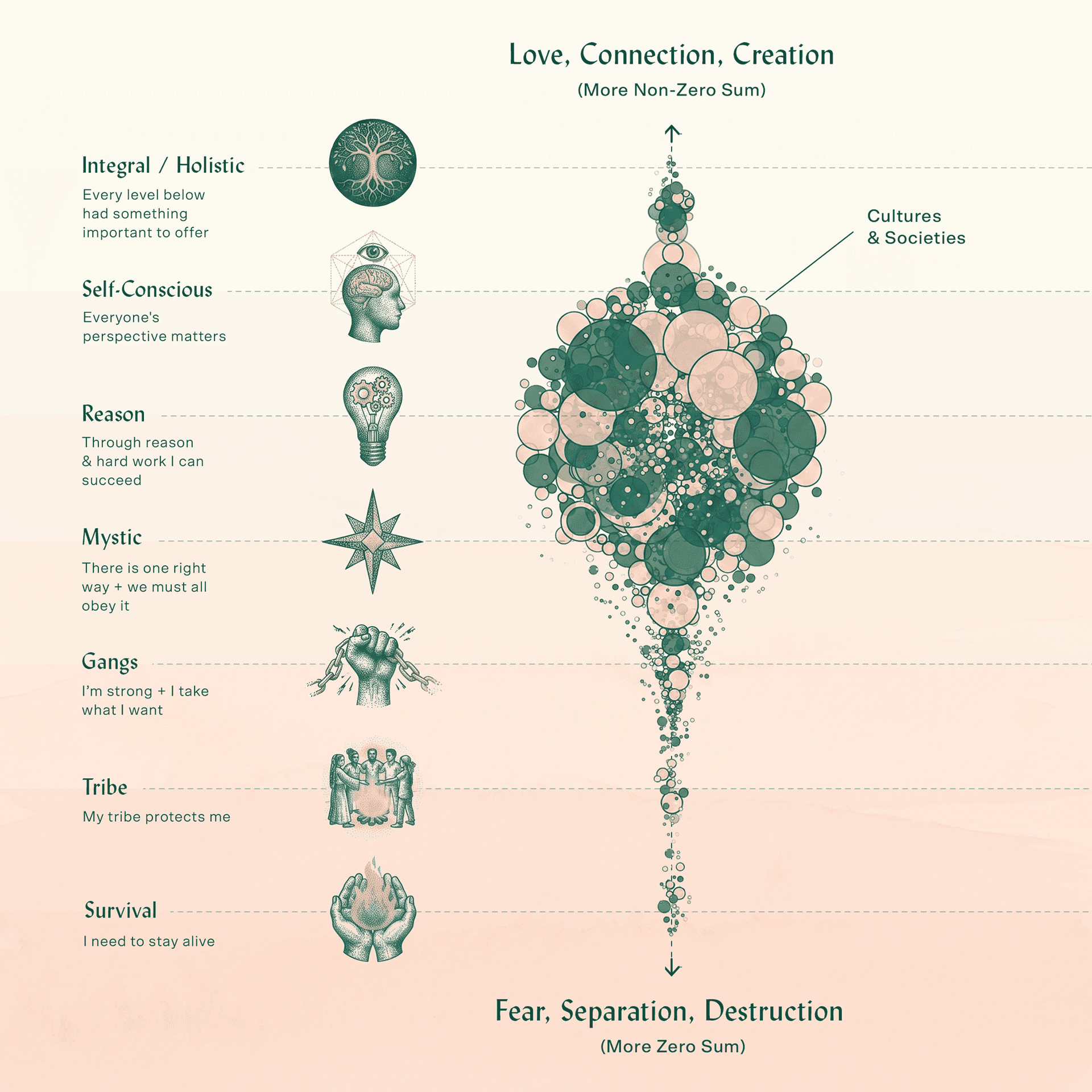
Unresolved trauma, insecurity and fear often make us compress the radius of our group consciousness. Healing, security, and love expand the radius of our group consciousness. The question is not: how do we destroy this instinct? The question is: how do we better understand this instinct so that we don’t stay needlessly caged? So that we consciously extend the radius of who counts as us?
The history of our global civilization proves this is possible, even if slow. The circle of moral concern has expanded across millennia - from the immediate family to the clan, from the clan to the tribe, from the tribe to the city-state, from the city-state to the nation state (and many other layers in between). Each expansion was resisted. Each was denounced as heretical, destabilizing, dangerous to the established order. Each eventually became unremarkable, absorbed into the background assumptions of people who could not imagine living under the previous arrangement.
The expansion, however, is not automatic. It does not happen through the mere passage of time or the benevolent unfolding of history. It happens when enough individuals do the difficult internal work of examining their own programming: of asking compassionately of oneself “where did this belief come from, who told me this was true, and what would I think if I had been born elsewhere?” It comes by seeing growth as preferable to stagnation and trusting that better ways of doing things lie ‘out there’.
This is what ‘metacognition’ means in practice: the act of exploring your own assumptions and finding a set of higher principles that are coherent with life’s diverse experiences. Mapping the sources of your convictions is not only a therapeutic exercise - it is a courageous political act that seeks to transcend your cultural inheritance and build a bigger castle.
It is the beginning of the only real freedom that is actually available to us.
“They live in wisdom who see themselves in all and all in them” — Krishna-Dwaipayana Vyasa, The Bhagavad Gita
Conclusion: The View from Above the Tracks
Return, one final time, to the image of the railway tracks.
From inside the carriage, your track looks like the world. Ascend high enough and you can see all the tracks and train cars at once - how many there are, how they crisscross the whole earth, how they were laid by human hands over centuries and for reasons that made sense at the time.
This is what the work of self-knowledge makes possible at the individual and the collective level: the ability to see your own track, with humility, from above. And with it, the freedom to build something new on top of the roots of your inheritance. The freedom to choose, with a higher consciousness, what strengths to keep, what outdated modes and pains to let go, and where to go next.
This is the difference between a life inherited randomly and a life chosen. Between a civilization that happens to people and a civilization that people choose consciously to build together. The leap towards our next civilizational horizon takes courage - do we have it?
What can we do in practice?
** Translation as infrastructure: People who navigate between civilizations carry something irreplaceable - trusted connections across different worlds. Cultural translation deserves the same institutional investment as roads and ports - diplomatic recruitment from civilizational junctions, curricula that treat code-switching as a core skill, envoys trained in the cosmologies of the civilizations they engage. Far cheaper than military deterrence, and more generative. Automatic translation of social media posts (like on X.com) is a promising start.
** Designed encounter: Contact reduces prejudice reliably under specific conditions: equal status and shared goals. The ISS, CERN, the Olympics, Fulbright, and Silicon Valley work precisely because they structure shared purpose between nominal equals. Civilizations don't need to become identical - they need more high-quality junctions.
** Immigration: Migrant integration works when designed rather than depending on soft idealism - host-country language acquisition, equal-status employment, sustained community encounter. These are the conditions under which integration actually functions, and under which host societies win.
** Treat collective trauma: The sequence — injury → shame → denial → supremacy → violence — is consistent enough to be treated as foreseeable. Three conditions break the cycle: acknowledgment of the original injustice; durable security for the traumatized group; and universality. Survivors cannot be permitted to victimize new groups. "Never again" is only a principle if it applies to everyone.
** Metacognition in education: Teach the origins of conviction alongside the content of knowledge - not relativism, but the discipline of asking: where did this certainty come from? What would I believe had I been born elsewhere? Which of my convictions survive as universal principles, and which control me at random?
** PS: Zulu Group has for several years supported the Earth Species Project, which uses AI to decode animal communication - in whales, birds, and beyond. The goal is not merely to understand their communication models but eventually to communicate with them ("The orca explained that his mother was in distress and asked for help"). If better diplomacy and translation can help human civilizations find common ground, imagine the impact that inter-species communication could have on planetary consciousness.
Some credits: David Bohm (language as a system), Ken Wilber (consciousness), Bhagavad Gita (eternal truths), David Eagleman (mechanics of empathy), Alexandra Asseily (ancestral healing), Gabor Maté (compassionate inquiry).
— David Bohm (1917-1992 CE)
Subscribe
Subscribe
Share to:
© 2025 Zulu Group Ltd. All rights reserved.